
Mega-Session Hair Transplants in Austin
More coverage in one carefully planned procedure, without giving up a natural result.
What is a mega-session?
A mega-session is a hair transplant that moves a large number of grafts, typically 3,500+, over two consecutive days. Instead of spreading your restoration across several surgeries a year or more apart, many patients with advanced hair loss can treat the hairline, front, mid-scalp and sometimes the crown in one plan.
A good mega-session isn't about chasing a big number. It's about moving the right number of grafts for your hair loss, your donor supply and your long-term plan.
Is a mega-session right for you?
You may be a good candidate if you have:
Moderate to advanced hair loss across a large area
Strong donor density (and good scalp laxity, if FUT is part of the plan)
A hair loss pattern that has stabilized or is being managed with medication
A goal of meaningful change with fewer surgeries and less total downtime
A mega-session usually isn't the best fit for early thinning, younger patients whose hair loss is still unpredictable, or anyone with a limited donor area. At your consultation, we measure your donor density, estimate how many grafts you can safely spare over your lifetime, and tell you honestly if a smaller session is the better choice.
Why patients choose Apex for a mega-session
Your surgeon is hands-on for the steps that matter most.
Dr. Hays personally harvests your grafts and creates every recipient site, the steps that most shape graft survival, hair direction and density.
Density where it counts.
When you're a good candidate, we design the frontal zone at densities up to about 50 follicular units per cm², dense enough to look full and planned to hold up as you age.
Natural hairline design.
Dr. Hays is fellowship-trained in hair restoration surgery. Your hairline is drawn by hand with you in the room, shaped to your face, age and ethnicity rather than a template.
FUE, FUT or both.
For very large sessions, combining FUT and FUE can increase the total grafts available while protecting your donor area. We'll recommend the approach that fits your scalp, not the one that's easiest to sell.
A personal practice.
One patient per day. The same team is with you from consultation through your final result.
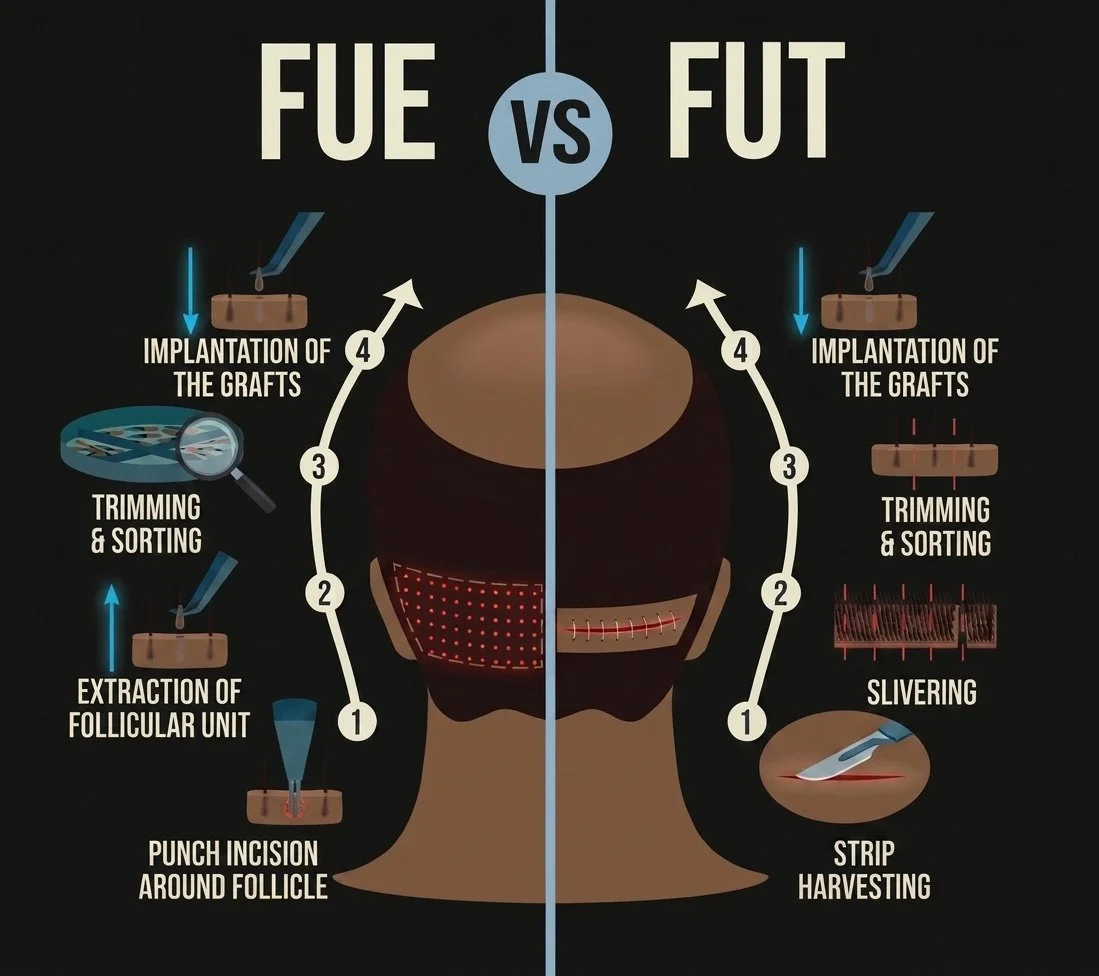
FUE, FUT and combined sessions
FUE: grafts are taken one at a time from the back and sides. No linear scar, so you can wear your hair short.
FUT (strip): a thin strip of scalp is removed and divided into grafts, leaving a fine linear scar hidden by your hair. Often yields a high number of grafts in one session.
Combined FUT + FUE: both in the same plan to get the most grafts while spreading out the impact on your donor area.
What to expect on the surgery days
Day 1
Morning: we review your plan, design and mark your hairline together, and take photos.
Numbing: local anesthesia keeps you comfortable. Most patients describe the injections as the only part they really feel.
Harvesting and site creation: Dr. Hays harvests your grafts and makes the recipient sites.
Placement: our team places the grafts while you relax, watch a show or nap, with breaks and lunch along the way.
Home the same day to rest for day 2.
Day 2
Morning: we review the plan, re-mark the hairline, and take photos.
Numbing: local anesthesia is administered.
Harvesting and site creation: Hairs are again harvested in-between the previous day’s sites while avoiding over-harvesting.
Placement: our team places the grafts while you relax, watch a show or nap, with breaks and lunch along the way.
Home for recovery
Recovery and results timeline
Days 1–10: small scabs and some swelling are normal. Most people return to desk work in about 7–10 days.
Weeks 2–8: transplanted hairs often shed. This is expected; the follicles stay in place.
Months 3–4: new growth begins.
Month 6: a visible change for most patients.
Months 12–18: final result, as the new hair thickens and matures.
You'll go home with detailed aftercare instructions and a direct line to our office for questions.
Planning for the long term
Your donor hair is limited, and hair loss can keep progressing after surgery. We plan your mega-session with that in mind, leaving reserve grafts for the future and talking through medical options that can help protect the hair you have.
Mega Session FAQ
Generally 3,500 grafts or more. Your number is based on your hair loss, donor supply and goals. The maximum single-day procedure typically will cap at 3,500 grafts, but, if planned appropriately and spaced out over two consecutive days, up to 6,000 grafts can be transplanted.
How many grafts is a mega-session?
1
Is it safe to move that many grafts at once?
2
In experienced hands and with the right candidate, yes. Graft survival depends on careful handling, keeping grafts hydrated and limiting their time outside the body, and precise site creation. We only recommend a mega-session when your donor area can support it.
That's the goal of every case. Natural results come from hairline design, correct hair angles and density placed where it matters most, not just from graft count.
Will it look natural?
3
You're numbed with local anesthesia. Most patients feel the initial injections and are comfortable for the rest of the day. Soreness afterward is usually mild and manageable.
Does it hurt?
4
Is it done in one day or two?
5
Most mega-sessions are done in two consecutive days.
Can a mega-session repair a past transplant?
6
Sometimes. Repair cases depend on what donor hair remains. We'll evaluate your scalp and prior work at your consultation.
New growth usually starts around months 3–4, with the full result at 12–18 months.
When will I see results?
7
OR
Send us an email